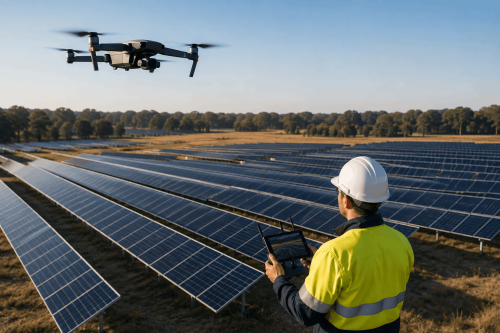
Drone thermal inspection for solar farms helps in detecting hotspots, module faults, and performance issues without disrupting generation. AUAV USA delivers geo-referenced thermal inspections for utility-scale solar assets. Explore our solar inspection capabilities.
Utility-scale solar farms can contain hundreds of thousands of PV modules spread across large sites. Inspecting them manually is time-consuming and can expose technicians to unnecessary time within operating electrical environments.
More solar operators in the US are turning to drone inspections. Drone thermal inspection provides a faster way to assess an entire array while it is generating. A properly equipped UAV can systematically capture thermal and visual data, identify abnormal heat signatures invisible to the naked eye, and pinpoint areas requiring further investigation.
For O&M teams, the benefit is not simply faster inspection. It is knowing where to send technicians first.
Drone thermal inspection for solar farms uses UAVs equipped with infrared and RGB cameras to identify hotspots, bypass diode failures, string anomalies, soiling, and other potential defects across large photovoltaic (PV) arrays without shutting down generation.
For US solar asset owners, choosing the right provider means verifying thermal imaging capability, inspection methodology, reporting standards, FAA compliance, and utility-scale experience. Inspection outputs should be geo-referenced, actionable for O&M teams, and aligned with recognized standards such as IEC 62446-3.
What Can Thermal Drones Detect on Solar Farms?
Thermal imaging identifies temperature variations across operating PV modules and strings. Depending on site conditions and inspection methodology, drones can help detect-
- Hotspots caused by cell defects, shading, contamination, or electrical issues
- Bypass diode anomalies that may reduce module performance without obvious visual damage
- String anomalies or disconnections producing abnormal thermal patterns
- Soiling and localized shading affecting module performance
- Cracked or damaged cells generating irregular heat signatures
- Underperforming areas requiring ground-level electrical investigation
Drone thermography works best as a high-speed diagnostic and triage tool. It identifies suspected faults across the asset so technicians can perform targeted testing and maintenance.
Interested in knowing more about how drone thermography can benefit your project?
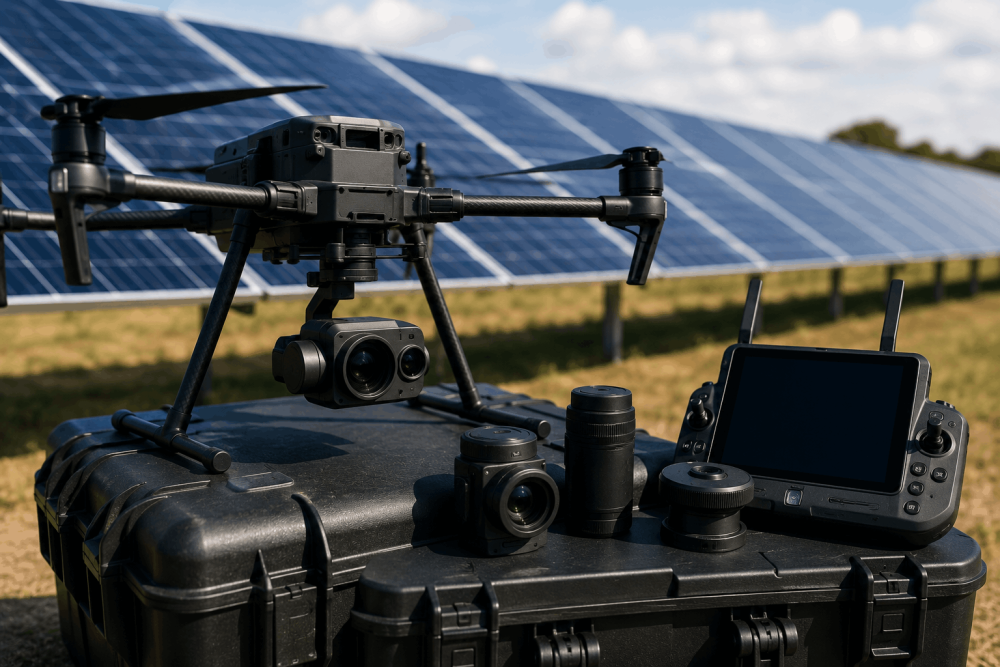
What Equipment Specifications Matter for Solar Thermography?
Asset owners do not need to become thermal-camera experts, but they should understand the specifications affecting inspection quality.
Thermal Sensitivity
High thermal sensitivity helps distinguish small temperature differences between healthy and potentially defective cells. Ask the provider for the NETD or thermal sensitivity of its sensor and why it is appropriate for PV inspection.
Radiometric Thermal Data
Confirm that the camera captures radiometric thermal imagery rather than simply producing colorized infrared pictures. Radiometric data allows temperature information to be analyzed during processing.
RGB Resolution
High-resolution visual imagery should accompany thermal findings. As a practical benchmark, ask whether the provider captures 20 MP or higher RGB imagery and how visual images are paired with thermal findings.
Ground Sampling Distance (GSD)
GSD determines how much physical area each image pixel represents and therefore affects module-level detection capability. Here’s what you should ask: ‘What GSD will you achieve at our site, and is it suitable for the defects we need to identify?’
Irradiance and Weather
PV thermography requires the array to be operating under sufficient, relatively stable solar irradiance. Around 600 W/m² or greater is commonly used as a practical benchmark, although the required conditions should follow the agreed inspection methodology and applicable standard.
Your provider should document irradiance and relevant environmental conditions during capture.
What Should a Professional Solar Inspection Report Include?
The deliverable should be more than a folder containing thousands of thermal images. Before commissioning an inspection, require-
- Geo-referenced fault maps
- Thermal and RGB imagery for identified anomalies
- Module-, string-, or array-level locations
- Defect or anomaly classification
- Severity or maintenance priority
- Searchable or sortable fault inventory
- Environmental conditions during inspection
- Clear identification of findings requiring ground verification
- Structured digital data for O&M workflows
Where repeat inspections are planned, reporting should also allow teams to compare asset condition over time.
AUAV combines aerial inspection with inSite™, its drone asset inspection and data management platform. This gives solar operators structured access to inspection findings and historical asset data instead of disconnected image folders.
What FAA Requirements Should a Drone Inspection Provider Meet?
Commercial drone operations in the United States generally fall under the FAA’s 14 CFR Part 107 regulations. Before work starts, verify that your provider addresses-
- FAA Remote Pilot certification
- Aircraft registration
- Remote ID requirements where applicable
- Controlled-airspace authorization where required
Any waivers or additional approvals required for the proposed operation
A remote solar farm should not automatically be treated as unrestricted airspace. Professional flight planning should account for airspace, nearby aviation activity, site hazards, terrain, and operating requirements.
What Else Should You Verify Before Hiring a Provider?
FAA compliance establishes whether a provider can legally conduct the flight. It does not establish whether the provider can deliver a useful solar inspection. Ask about-
- Utility-scale solar inspection experience
- Projects of comparable size and terrain
- Alignment with IEC 62446-3 or another defined PV thermography standard
- Safety and quality management systems
- Insurance coverage
- Thermal analysis expertise
- Data security and hosting
- Quality assurance procedures
- Consistency across multi-site or recurring inspection programs
Also ask who will actually perform the fieldwork. Consistent teams, equipment, methodology, and processing become particularly important when comparing results across an entire solar portfolio.
Common Mistakes When Commissioning a Solar Drone Inspection
Choosing on price alone: A low-cost flight becomes expensive if the data must be recollected because resolution, weather conditions, or reporting requirements were inadequate.
Commissioning a flight instead of an outcome
Specify the faults you want identified, required resolution, location accuracy, reporting format, and maintenance deliverables.
Ignoring environmental conditions
Thermal data collected under unsuitable irradiance or weather conditions may provide limited diagnostic value.
Accepting an image dump
Thousands of infrared images are not a maintenance plan. Findings should be located, classified, and prioritized.
How Much Does a Solar Farm Drone Inspection Cost in the US?
There is no single standard price. Inspection costs typically depend on various factors.
- Installed capacity and acreage
- Site location and mobilization
- Array layout and terrain
- Required thermal resolution
- Airspace complexity
- Analysis and reporting requirements
- Data hosting
- Number of sites
When comparing quotes, make sure each provider is pricing the same deliverable. A lower per-MW or per-acre rate may exclude detailed thermal analysis, defect classification, reporting, or ongoing data hosting.
AUAV provides project-specific pricing based on the solar asset and required inspection scope.
Commission a Solar Farm Thermal Inspection with AUAV USA
Founded in 2013, AUAV provides professional drone inspection and data solutions in the United States and internationally, including thermal inspection for utility-scale solar assets.
AUAV combines professional aerial data capture, specialist processing, and structured asset information through inSite™, helping O&M teams move from thermal anomaly to maintenance action.
For US solar asset owners, the objective is not simply to fly every row of panels. It is to obtain reliable, repeatable inspection data that helps protect generation and prioritize maintenance.
Contact AUAV USA to discuss your solar farm, required deliverables, and project-specific inspection scope.
Frequently Asked Questions
Can thermal drone inspections be completed without shutting down generation?
Yes. Solar thermography requires modules to be operating under sufficient irradiance to generate meaningful thermal contrast. A routine aerial thermal inspection therefore does not normally require a generation shutdown.
How often should a utility-scale solar farm be inspected?
Inspection frequency depends on asset age, operating history, maintenance strategy, environmental exposure, and contractual requirements. Annual thermal inspections may form part of preventative O&M programs, with additional inspections following severe weather or before important warranty milestones.
Does a commercial solar drone inspection require FAA approval?
Commercial small-UAS operations are generally conducted under FAA Part 107. Controlled airspace may require FAA authorization, while certain operations outside standard Part 107 limitations may require additional approval or waivers.
What is IEC 62446-3?
IEC 62446-3 is an international standard covering outdoor infrared thermography of photovoltaic modules and plants. Asking providers whether their methodology aligns with IEC 62446-3 gives asset owners a defined benchmark for inspection and reporting quality.
Can thermal drones detect every solar panel defect?
No. Drone thermography is primarily a rapid screening and diagnostic method. Some anomalies require ground-level electrical testing or physical inspection to confirm the underlying cause.